















What Is a Fiber Laser Diode and How Does It Work?
A Fiber Laser Diode sits at the meeting point of semiconductor engineering and precision photonics. The term can describe a diode that pumps light into an optical fiber, or a compact laser source coupled directly to fiber. That distinction matters. Many explanations blur it.
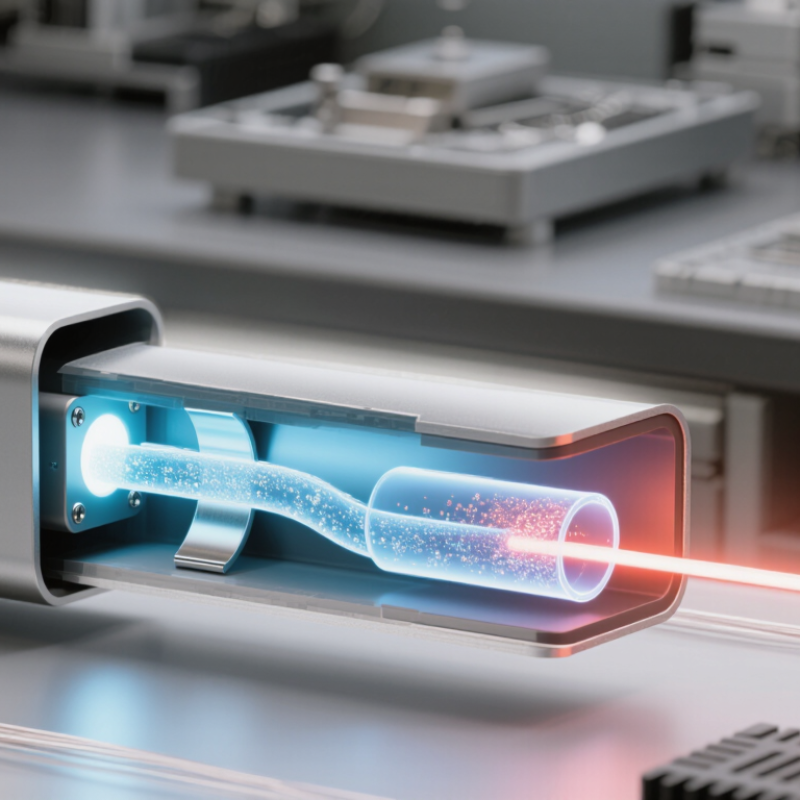
Valentin Gapontsev, a pioneer of high-power fiber lasers, is often credited with saying, “The future of lasers is in fiber.” His view reflects a practical advantage. A Fiber Laser Diode can deliver concentrated optical energy through a thin, flexible waveguide. Inside a typical system, a semiconductor diode produces pump light. The doped fiber absorbs that light and excites its rare-earth ions. As the ions return to a lower energy state, they release photons. Stimulated emission strengthens those photons. Fiber Bragg gratings, mirrors, or another optical cavity then shape the beam.
The process sounds neat. Real systems are less perfect. Heat, coupling loss, fiber bending, and connector contamination can reduce performance. Engineers must also balance output power, wavelength, beam quality, and service life. A carefully aligned diode may still underperform in a poorly designed module.
This article explains how a Fiber Laser Diode works, from electrical input to optical output. It also examines common architectures, key materials, efficiency limits, and industrial applications. You will see what happens inside the fiber. More importantly, you will see why small design choices can change the final beam.
What Is a Fiber Laser Diode?
A fiber laser diode is usually a semiconductor pump source connected to an optical fiber. It is not the complete fiber laser. The diode converts electrical energy into light, often near 915 or 976 nanometers. That light enters a doped fiber, where ytterbium or erbium ions amplify it. Mirrors or fiber Bragg gratings then form the laser cavity. The output can be narrow, stable, and highly directional.
The term is slightly misleading. A diode may be fiber-coupled, while the laser gain medium remains inside the fiber. This design improves beam delivery and removes heat from the active region. According to MarketsandMarkets’ 2024 Fiber Lasers Market report, the sector is projected to grow from about 7 billion dollars in 2024 to more than 10 billion dollars by 2029. Yole Group’s 2024 laser diode industry analysis also identifies industrial processing and communications as major demand areas. Real performance still depends on coupling loss, cooling, wavelength stability, and fiber quality.
Tips: Check the diode’s operating wavelength, optical power, coupling type, and temperature range. A higher-power diode is not automatically better. In practice, poor alignment can waste valuable light, and published efficiency figures may reflect ideal laboratory conditions. That detail is easy to overlook.
